


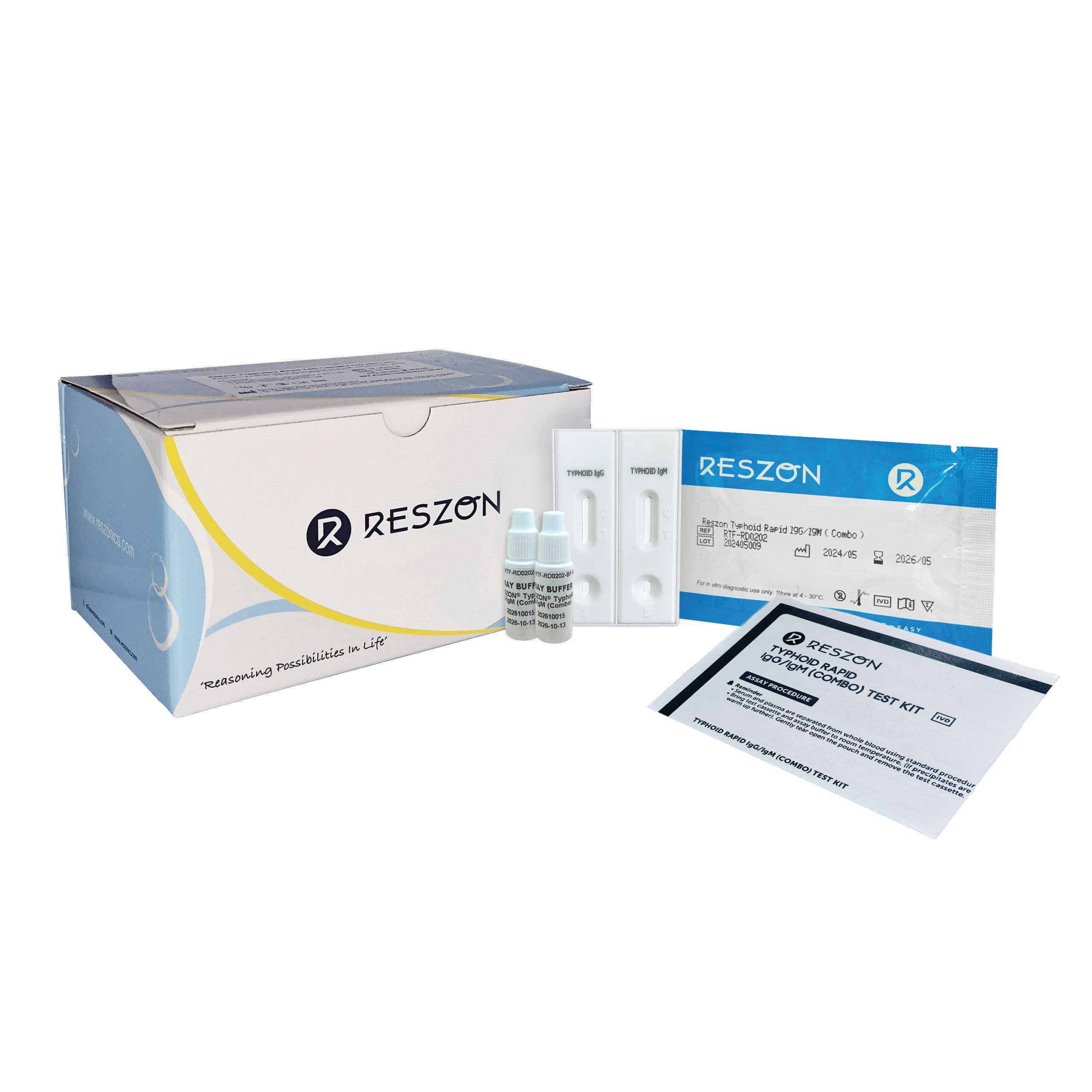


RESZON® TYPHOID RAPID IgG/IgM (COMBO) TEST KIT
This webpage content is intended for Healthcare Professionals only, not for general public. Registered under Act 737
MDA registration number: IVDC85711391719
FEATURES
- Rapid immunochromatography assay for detection of typhoid fever
- Detect IgM and IgG antibodies against specific Salmonella typhi OMP antigen
- Simple to perform & no special equipment required
TEST KIT SPECIFICATION
| Platform | Immunochromatographic Assay |
| Format | Cassette |
| Detection | IgM and IgG antibodies against specific Salmonella typhi OMP antigen |
| Specimen | Human serum, plasma or whole blood |
| Specimen Volume | 45 µl |
| Sensitivity | IgG: 94.44% IgM: 91.67% |
| Specificity | IgG: 93.40% IgM: 95.24% |
| Assay Time | 10-15 minutes |
| Shelf Life* | 24 months |
*From date of manufacture


|
Cat. No. |
Product Description |
Test Specimen* |
Product Format |
Intended Use |
Intended Use |
Storage Temp. |
Packing Size |
|---|---|---|---|---|---|---|---|
|
RTF-RD0202 |
RESZON® Typhoid Rapid IgG/IgM (Combo) Test Kit |
WB/S/P |
Cassette |
IgM and IgG antibodies against specific Salmonella typhi OMP antigen |
For Professional Use |
2-30°C |
25 T/ Kit |
* S – Serum; P – Plasma; WB – Whole Blood; T – Test
Frequently Asked Questions (FAQ)
Before running the test
1. Can I use the test device if the pouch is damaged or there is broken/ incomplete seal?
No. Do not use the test device if the pouch is damaged or the seal is broken/ incomplete. Please use a new test.
2. Can I use the test device if there is no desiccant in the pouch?
No. Desiccant should come together with test device in the pouch. Please use a new test.
3. Can I use the kit beyond its expiry date?
No. User should not use the test beyond the expiry date shown on the test kit labelling.
While running the test
4. Can I use specimen directly from the refrigerator?
No. Refrigerated specimen should be equilibrated to room temperature (about 30 minutes) or between 15oC and 30oC before being tested. Remember to mix the specimen before use.
5. Can I use haemolyzed specimen?
No. Haemolyzed specimen cannot be used on this test. Haemolyzed samples may interfere with test results. The use of grossly lipemic or turbid samples should also be
avoided.
6. Can I use whole blood sample from finger prick?
Yes. Whole blood sample from finger prick can be used. However, skillful professional user and a suitable lancet are required to ensure sufficient specimen can be collected. It is highly recommended to use whole blood sample from venipuncture.
7. I found that the bu er is not enough to run the test in the kit. Can I use buffer from other brand?
No. Buffer from other brand cannot be used as a substitute for the buffer in this kit. Please contact your supplier for assistance.
The buffer provided in the kit are more than the actual volume needed to run all 25 tests in the kit. User should check the IFU again and ensure that the tests are run following the correct assay procedure.
8. Can I put more sample to the test? What if I accidentally added more sample to the test?
No. User should follow the instruction of the assay procedure strictly. Failure to follow the instruction may give inaccurate test results. Repeat the test if the sample volume is incorrect during the testing.
9. Why is it the sample never flow up, or the sample only flow half of the test window?
It may be due to insufficient specimen or buffer volume. Sufficient amount of specimen and buffer are important to ensure the sample to flow up properly. Please repeat the test with a new test device if invalid results are observed.
When adding buffer, it is important to hold the buffer bottle vertically, carefully press the bottle to release full drop of buffer, one drop by one drop. The droplet volume of the buffer may be inconsistent if the buffer bottle is not held vertically above the well “S”, or buffer being released too fast.
10. Can we add more bu er if the sample is not flowing up?
No. The assay procedures need to be followed strictly. If no sample flow is observed, check again the procedure and repeat the test with a new test device.
11. Can I read results before 20 minutes?
Results can be read from 15-20 minutes.
12. Can I read results after 20 minutes?
No. Do not read results after 20 minutes. Results read after 20 minutes may lead to a false positive, false negative, or invalid result.
Interpretation of results
13. What do the results mean?
If coloured bands appear at the control line (C) and test lines (IgG and/or IgM), it indicates a positive result. Positive results indicate the presence of specific Salmonella typhi antibodies in the specimen. Positive result should not be used as the sole criteria for the diagnosis of typhoid infection. Positives results should be confirmed by alternative testing method and clinical finding before positive determination is made.
The result is negative if only control line (C) is visible with no coloured line developed at test line (T) positions. This indicates that S. typhi antibody has not been detected. Negative result does not preclude the possibility of exposure to or typhoid infection. It is recommended that the results obtained be interpreted in conjunction with other diagnostic results and clinical information.
14. What to do if the results showed negative result, but the symptoms persist?
If the symptom persists, while the result is negative or non-reactive result, it is recommended to re-sample the patient a few days later or use alternative testing such as blood culture, PCR or ELISA method.
After running the test
15. What should I do after running the test?
Handle all materials that come in contact with patient samples as infectious waste and dispose in a biohazard container.
Good Laboratory Practice
16. How is the good quality control for RESZON® Typhoid Rapid IgG/IgM (Combo) Test Kit?
Users should follow respective Good Laboratory Practice SOP of the labs. However, it is recommended to use external controls, positive and negative, to confirm the test procedure and to verify proper test performance, particularly under the following circumstances:
- New operator uses the kit, prior to performing testing of specimens.
- A new lot of test kits is used.
- A new shipment of test kits is used.
- The temperature used during storage of the kit falls outside of 2-30°C.
- The temperature of the test area falls outside of 15-30°C.
- To verify a higher-than-expected frequency of positive or negative results.
- To investigate the cause of repeated invalid results.