
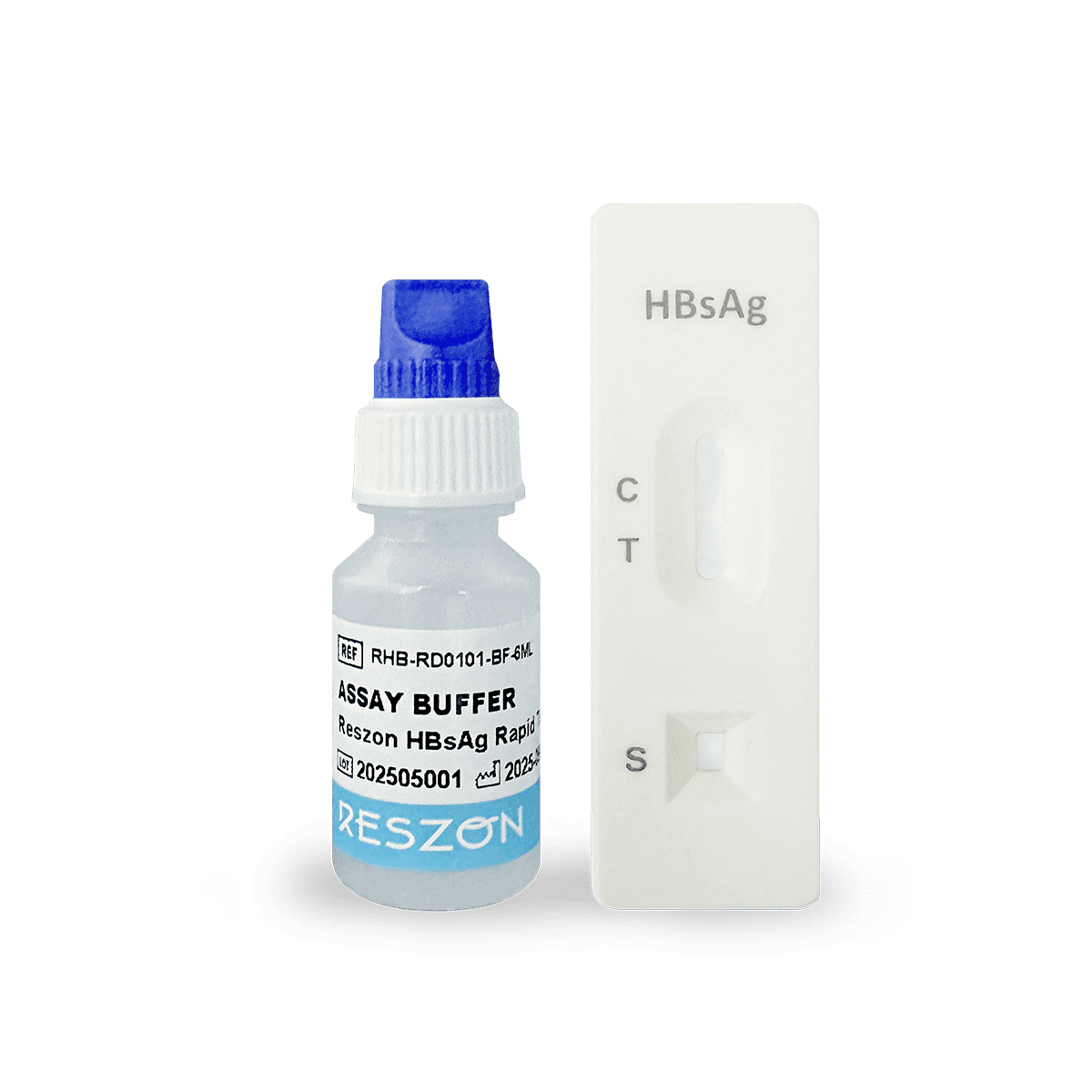


RESZON® HBsAg RAPID TEST
This webpage content is intended for Healthcare Professionals only, not for general public. Registered under Act 737
MDA Registration Number: IVDD4340025-214346
FEATURES
- Rapid immunochromatography assay for qualitative detection of Hepatitis B surface antigen (HBsAg)
- Specimen: Human whole blood, serum, plasma
- Fast result in 20 minutes
- Simple to perform & no special equipment required
For professional in vitro diagnostic use only
TEST KIT SPECIFICATION
| Platform | Immunochromatographic Assay |
| Format | Cassette |
| Detection | Hepatitis B surface antigen |
| Specimen | Human whole blood, serum & plasma |
| Specimen volume | 75 μl |
| Sensitivity | 99.3% |
| Specificity | 99.8% |
| Storage | 2-30°C |
| Assay Time | 15-20 minutes |
| Shelf Life* | 24 months |
*From date of manufacture


|
Cat. No. |
Product Description |
Test Specimen* |
Product Format |
Intended Use |
Intended Use |
Storage Temp. |
Packing Size |
|---|---|---|---|---|---|---|---|
|
RHB-RD0101-25 |
RESZON® HBsAg Rapid Test |
S/P/WB |
Cassette |
Detection of Hepatitis B surface antigen (HBsAg) |
For Professional Use |
2-30oC |
25 T/ Kit |
|
RHB-RD0101A-25 |
RESZON® HBsAg Rapid Test |
S/P/WB |
Cassette |
Detection of Hepatitis B surface antigen (HBsAg) |
For Professional Use |
2-30oC |
25 T/ Kit |
|
RHB-RD0101B-25 |
RESZON® HBsAg Rapid Test |
S/P/WB |
Cassette |
Detection of Hepatitis B surface antigen (HBsAg) |
For Professional Use |
2-30oC |
25 T/ Kit |
* S – Serum; P – Plasma; WB – Whole Blood; T – Test
Featured Stories & Articles
Frequently Asked Questions (FAQ)
1. What is RESZON HbsAg Rapid Test used for?
RESZON® HBsAg Rapid Test is a diagnostic tool used to detect Hepatitis B surface antigen (HBsAg) in human whole blood, plasma or serum samples. It helps identify current Hepatitis B virus (HBV) infection.
2. How does the test work?
The test is based on immunochromatography. If HBsAg is present in the sample, it will bind to specific antibodies in the test, producing a visible line on the strip.
3. How is Hepatitis B Virus (HBV) transmitted?
HBV is highly infectious and spreads through:
- Blood-to-blood contact – sharing needles, syringes, razors, toothbrushes, or through unsafe blood transfusions.
- Sexual contact – unprotected sex with an infected person (virus is present in semen and vaginal fluids).
- Mother-to-child transmission – during childbirth (a major route in high-prevalence regions).
- Close household contact – through open cuts or sores (less common).
Reference: https://www.who.int/news-room/fact-sheets/detail/hepatitis-b
4. Who should get tested for HBV?
- Individuals who suspect they may have been exposed to Hepatitis B.
- All pregnant women during each pregnancy, preferably in the first trimester, regardless of vaccination status or history of testing.
- People in high-risk groups (e.g., healthcare and emergency response workers exposed to blood or body fluids, people with multiple sexual partners, or Intravenous drug users, people undergoing dialysis or with chronic kidney disease, people with HIV or hepatitis C).
5. Why should you get tested for HBV?
Chronic HBV infection can lead to substantial morbidity and mortality but is detectable before the development of severe liver disease using reliable and inexpensive screening tests. More than half of people with hepatitis B are unaware of their infection status, and approximately 50%–70% of people with acute hepatitis B are asymptomatic. Without testing, people with hepatitis B virus (HBV) infection can unknowingly transmit the virus to others.
6. What sample type is required?
Human whole blood, serum, or plasma.
7. How soon can I test after exposure to HbsAg?
HBsAg may appear in the blood 1 to 9 weeks after exposure. If you test too early, the result may be negative even if infected.
8. How long does it take to get results?
The test provides results within 15–20 minutes.
9. What does a positive result mean?
A positive result indicates that Hepatitis B surface antigen is present, suggesting a current Hepatitis B infection. You should consult a healthcare professional for further testing and confirmation.
10. What does a negative result mean?
A negative result means no detectable HBsAg was found. However, this does not entirely rule out infection, especially in the early window period. Retesting after a few weeks is advised, if you suspect you have been exposed to Hepatitis B infection.
11. Do I need to prepare before the test?
No special preparation is needed. You can eat and drink normally before the test.
12. Is the test painful?
Only a small finger prick or blood draw is required. Any discomfort is minimal and short-lived.